“The Dream of Sleep” by Dorothea Zwirner
Aubrey Levinthal shows her new paintings in Berlin
The US painter has chosen two prominent role models whose works can also be seen at Galerie Haverkampf Leistenschneider | By Dorothea Zwirner
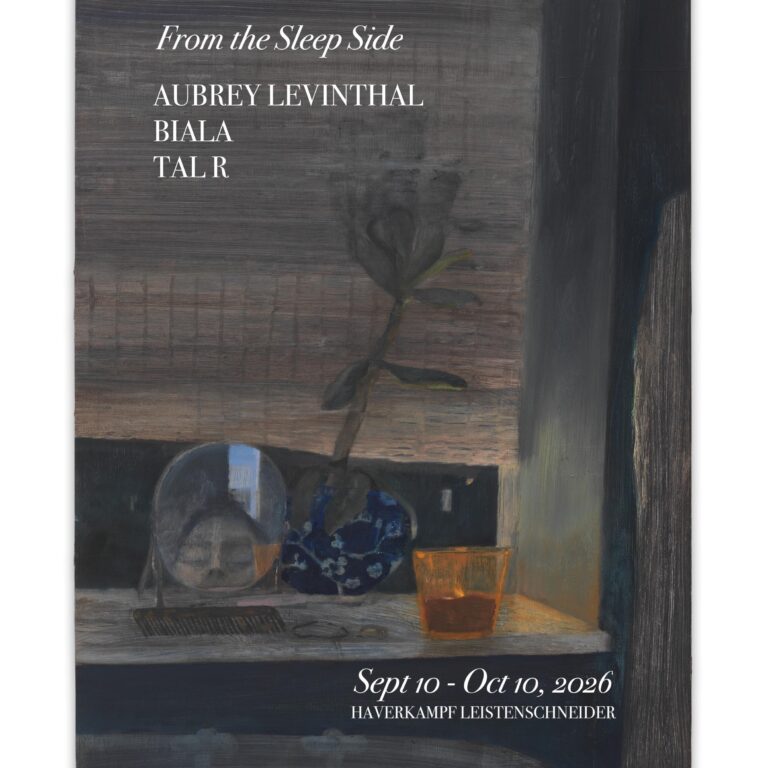
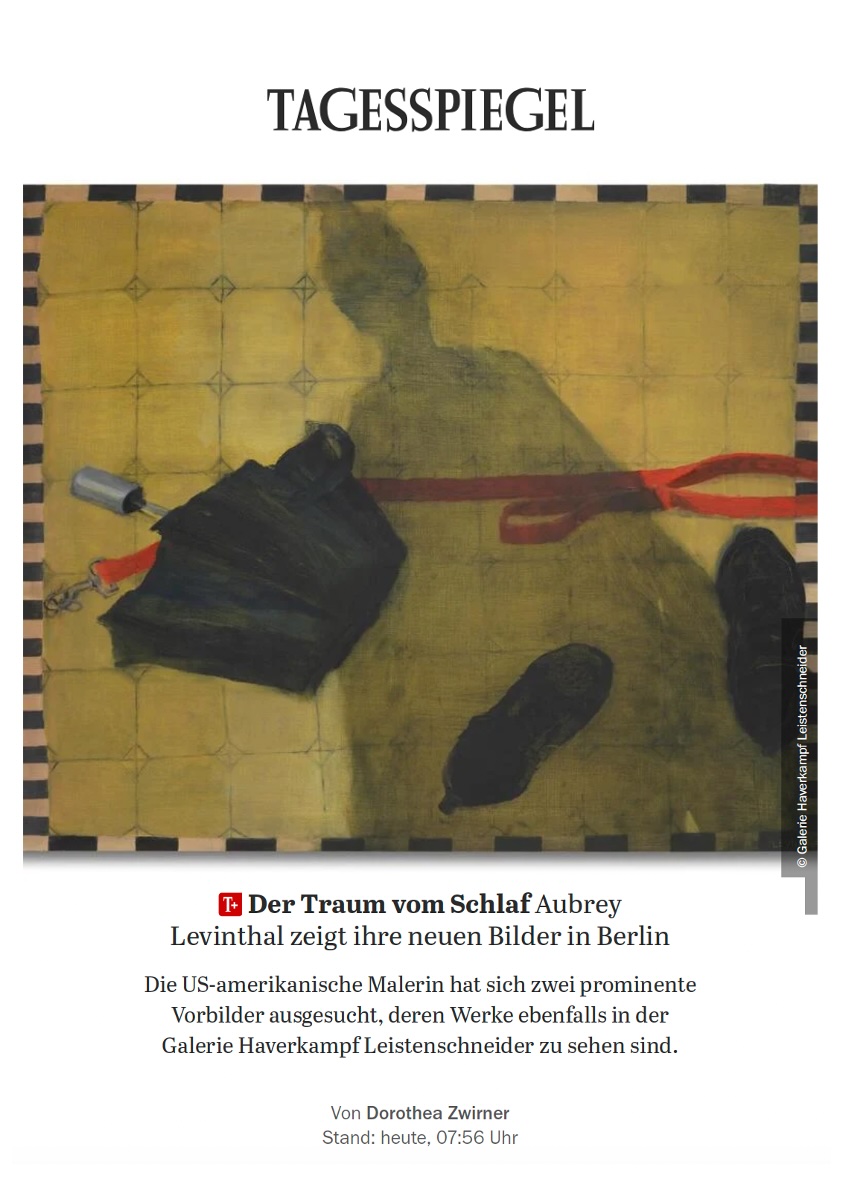
A pair of black sneakers, a small black umbrella, and a red dog leash lie scattered on the ochre tiles. From a bird’s-eye perspective, “Vestibule with Shadow” appears like a still life framed by a surrounding striped band. But a shadow falls diagonally across the image, darkening the vestibule and obscuring the perspective. Out of everyday objects and scenes, the US artist Aubrey Levinthal creates an atmospheric density that is situated somewhere between dream and reality, casual narrative and pure painting. These are dreamlike images “From the Sleep Side,” as the title of her third exhibition at Galerie Haverkampf Leistenschneider reads. Levinthal shows them in dialogue with two artistic positions that belong to her sources of inspiration: the painter Biala (Janice Biala), who lived from 1903 to 2000, and Tal R.
Rarely does an artist get such an opportunity to show her work alongside that of her role models – especially since they do not belong to the gallery’s regular program. From a list suggested by Levinthal, the gallery selected two artists who were accessible and suitable for them. Thus, three generations from two continents form an art-historical line of tradition in which Levinthal situates her own painting.
In the case of the artist, who was born in Philadelphia in 1986 and lives there, her flat, skillfully awkward style of painting immediately catches the eye, combining completely different applications of paint, degrees of completion, expressive values, and perspectives in one and the same picture. Opaque areas and scrapings emerge from the fluid application of paint; individual accents of color shine next to washed-out everyday colors; affectionate descriptions of detail are added to the cursory sections.
Unusual image crops, distortions, and perspective foreshortenings open up multiple perspectives, as if they wanted to grant a view from the outside and inside at the same time. They follow a compositional and emotional logic rather than a spatial one. Thus, “Pigeon’s View of the Studio” imagines the view of a pigeon (not depicted) into the studio, which is only hinted at by a picture rack. From this angle, it is possible to understand, so to speak, how a composition in warm red tones with complementary green emerged from the artist’s profile head (depicted).
Radical Tenderness
It is such everyday observations that tell of life in a realistic, unsentimental, and prosaic way without being narrative. They do not tell stories, but mostly about the attitude towards life of a woman and artist who moves between inner and outer perspectives, public and private space. Even if the artist herself can be recognized in the frequently depicted dark-haired woman, these are less self-portraits than typical everyday images or mood pieces of human loneliness, indefinite melancholy, and radical tenderness. Even in “Selfportrait under Geranium,” the self-image almost vanishes at the lower edge of the picture in favor of a romantic still life with flowers in shades of pink and gray.
Also in “Tub Ledge,” it appears only as a tiny reflection in the cosmetic mirror, which becomes an atmospheric interior still life by candlelight on the windowsill above the edge of the bathtub. Familiar details protect against too much nostalgic atmosphere, such as the hair tie with a few hairs caught in it, or the Ear-Pod case lying around next to a seashell in “Summer Mirror with Woman’s Head”.
It may be a coincidence that a reclining woman’s head with a hair bun also appears in “Women Sleeping with Flowers” by Tal R, as does the mirror motif in his work on paper “Mirror”. Beyond motivic agreements, both are connected by the alienation of the everyday, whereby familiar spaces and objects tip into a dreamlike, slightly irritating state. But unlike the artist, who was born in Tel Aviv in 1967 and grew up in Denmark, and whose expressive, highly colorful visual language combines a childlike openness with the elusive fleetingness of his dream world, Levinthal’s paintings are much quieter and more intimate.
An Almost Forgotten Artist
Her connection to Janice Biala, who is largely unknown in this country, is more obvious. With “Standing Figure” from 1953, Biala created a gorgeous portrait of a woman with long, dark hair, which coincidentally also bears the features of Levinthal. Born in 1903 as Schenehaia Tworkovska in Biała Podlaska, Poland, she emigrated from Europe as a Jewish artist in 1939 and developed an independent visual language that combines European modernism and post-impressionism with the gestural energy of the New York School. Although numerous large museums in Europe and the USA, such as the Whitney Museum and the Centre Pompidou in Paris, purchased her works, she fell into oblivion.
Levinthal discovered her work back in 2010 at an exhibition in New York and described the encounter as immediately influential. Biala’s restraint, intimacy, color palette, and her handling of everyday motifs impressed her so much that she even had “Black Still Life with Artichokes” from 1986 printed on a T-shirt. The fact that it now hangs in the original between her own pictures is one of those rare art-historical coincidences in which a role model suddenly becomes a counterpart.
Levinthal’s painting catches on the fine line between poetry and prose. Four out of seven paintings ($18,000–$28,000) were already sold at the opening; the Kunstverein Dresden is planning an exhibition for next spring.